- Home
- Departments
- Community Development
- Planning Division
- Long-Range Planning
- Safety Element Update
Safety Element Update
San Bruno is updating the Safety Element of the General Plan.
California State law requires that local governments prepare and adopt a general plan, which is a blueprint for meeting the community’s long-term vision for the future. The safety element is one of the nine State-mandated elements of the general plan. The goal of the Safety Element is to reduce the potential short and long-term risk of death, injuries, property damage, and economic and social dislocation resulting from fires, floods, droughts, earthquakes, landslides, climate change, and other identified hazards. Recent State of California legislation requires that safety elements be reviewed and updated as necessary alongside the 2023 – 2031 Housing Element update.
San Bruno is in the process of updating its Safety Element in collaboration with several jurisdictions in San Mateo County including Atherton, Belmont, Brisbane, Burlingame, Half Moon Bay, San Bruno, and San Mateo County. The collaborative effort is referred to as the Peninsula Resilience Planning (PREP) project. PREP is a project to study how natural hazards and climate change will harm our communities, and to plan for a safer and more resilient future.
The main components of the Safety Element update are:
- A vulnerability assessment that integrates updated background information and mapping;
- Amendments to goals, policies, objectives, and implementation measures, especially as they relate to climate change resiliency; and
- Alignment of programs from other city documents.
To learn more about the PREP project and sign up for email alerts for upcoming events and project milestones visit the project website, www.prepsmc.com.
Public Draft Safety Element
The public review period for the Public Draft Safety Element was February 5 - March 9, 2026. The Planning Commission's February 17, 2026, meeting also included a presentation of the Safety Element updates and an opportunity for public comment.
Changes are shown in strikethrough and underline and are focused on content required by State law to address climate change adaptation and resilience to risks such as wildfire, flood, drought, and extreme heat. State-law driven updates have also been made to the Public Facilities and Services Element and the Environmental Resources and Conservation Element. The final documents will be available in Spring of 2026, and the public draft documents are available in the interim below:
Public Draft Health and Safety Element Update
Public Draft Public Facilities and Services Element Update
Public Draft Environmental Resources and Conservation Element Update
Frequently Asked Questions
- What is the Safety Element?
- How can residents be involved in the update?
- Why update the Safety Element now?
- Why is this a Multijurisdictional effort?
- How is the Safety Element currently implemented?
- How does the Safety Element relate to the Housing Element?
- How is climate change and resilience being considered in the Safety Element update?
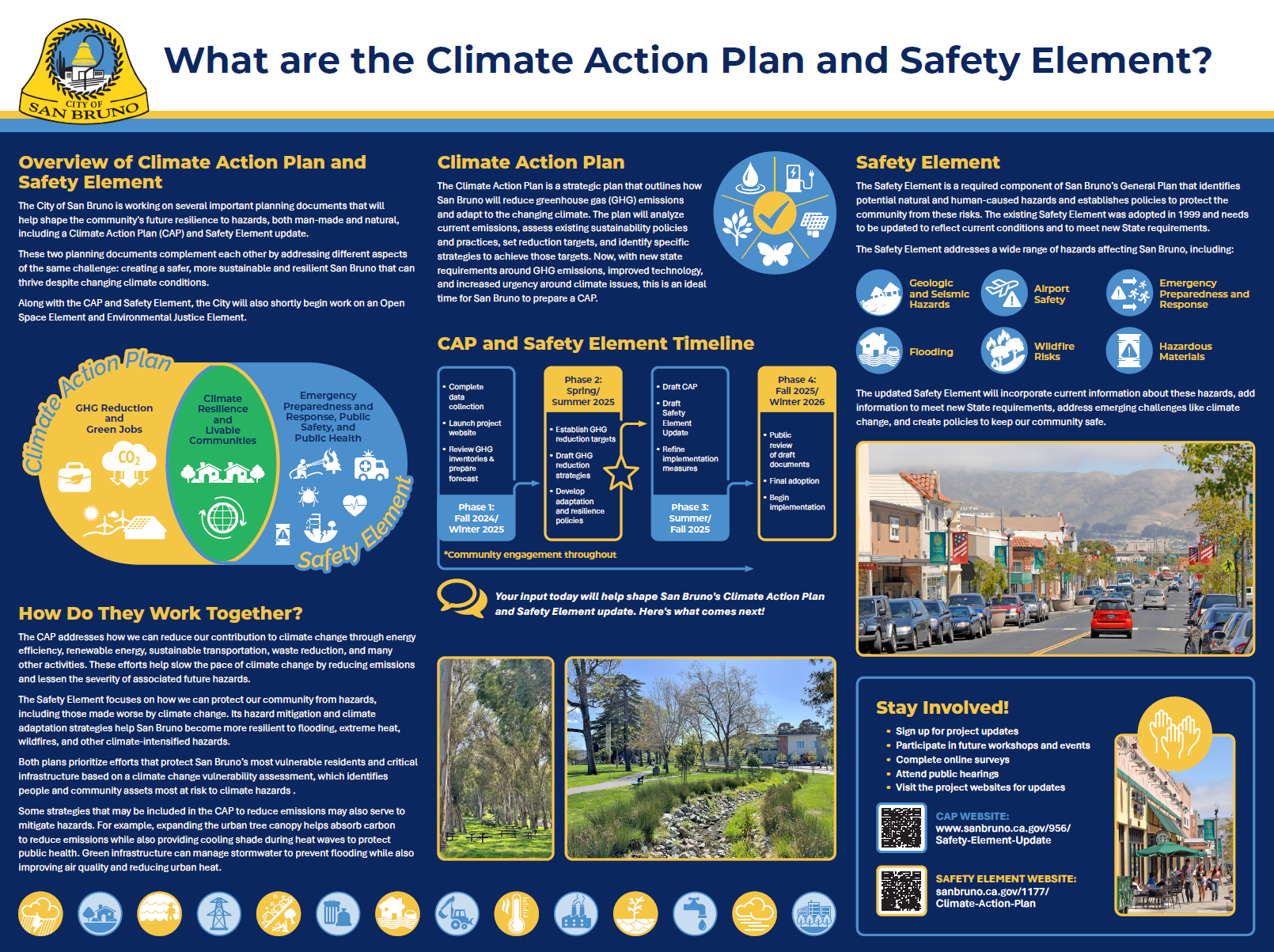
The safety element is one of the nine State-mandated elements of the general plan. State law requires a local government’s safety element to address protection of its people from unreasonable risks associated with disasters, including earthquakes, floods, fires, and landslides. Other locally relevant safety issues, such as airport land use, emergency response, and hazardous materials spills may also be included. New state laws also require safety elements to address climate change resilience.
Community meetings and workshops will be scheduled throughout the process to receive input from residents. The preliminary project timeline below indicates when community engagement will be incorporated into the process. The public will also have opportunities to review and comment on the document when it is reviewed by Planning Commission and City Council. Members of the public are encouraged to participate in those important discussions.
New state laws require local governments to update their safety elements alongside their housing element updates and require them to include climate adaptation and resilience strategies in the update. California Government Code Section 65302(g) describes required background information and provides policy and program guidance for safety element updates.
- SB 379: Incorporation of climate change adaptation and resilience, prepare vulnerability assessments to identify the risks from climate change hazards, and develop adaptation and resilience goals, policies, and implementation actions to increase community adaptation and build resilience. (§65302(g)(4))
- SB 1035: Builds off SB 379 and requires review and update portions of the safety element upon each revision of the housing element or local hazard mitigation plan (LHMP), but not less than once every 8 years. (§65302(c))
- SB 99: Identify evacuation-constrained areas specifically residential developments in hazard areas that do not have at minimum two evacuation routes. (§ 65302(g)(5))
- SB 1241: Increased requirements for flood and wildfire sections where responsible agencies are identified for protection against these hazards and refining policies to minimize risk for new buildings and essential facilities. (§65302(g)(1-3))
- AB 747: Requires jurisdictions to identify evacuation routes and their capacity. safety, and viability under a range of emergency scenarios. *This work is being done as part of a separate effort and is not part of the Multi-jurisdictional Safety Element project. (§65302.15)
- AB 2140: Incorporation of the LHMP. (§8685.9, §65302.6))
For many of these communities, there is a significant amount of overlap in the types of hazard conditions they must address, as well as common service providers, natural resources, and infrastructure. A multijurisdictional Safety Element update process builds on the accomplishments of hazard reduction programs and accomplishments in other jurisdictions, including the recently updated Mulltijurisdictional Local Hazard Mitigation Plan, and efforts launched by OneShoreline, and Sea Change San Mateo County.
The current Safety Element as well as the Local Hazard Mitigation Plan is implemented by several City departments.
- The Emergency Operations Center (EOC) is responsible for implementing those sections of the Safety Element that integrate portions of the Emergency Operations Plan.
- The Planning Division within the Community Development Department is responsible for implementing the land use portions of the Safety Element.
- The Building Division within the Community Development Department administers and revises the Building Code to maximize the resilience of new and existing structures.
- The Fire Department develops and implements regulations like mandated brush clearance.
- The Safety Element update involves representatives from across these departments to help integrate programs from other plans and review policies for conformity with their programs and responsibilities.
The Safety Element must be consistent with the General Plan, including the Housing Element. The Safety Element lays the groundwork for citywide hazard planning and programming and identifies measure to minimize impacts of environmental hazards. When considering recommendations to meet the San Bruno’s Housing Needs Allocation, measures to develop housing safely will be considered.
Consistent with state guidance on incorporating climate adaptation strategies and implementation measures into safety elements, a vulnerability assessment will be prepared to determine public safety risks from climate change, including flooding, wildfire, drought, extreme heat, sea level rise, and storm activity. The assessment will be shared with the public and discussed during our public outreach.
Safety Element Project Timeline
| PROJECT TIMELINE | SCHEDULE |
|---|---|
| Project Launch and Community Engagement Plan | July 2023 - October 2023 |
| Compile Background Information on Hazards* | August 2023 - January 2024 |
| Conduct Vulnerability Assessment* | December 2023 - June 2024 |
| Prepare Goals, Objectives, Policies* | March 2024 - August 2024 |
| Prepare Implementation Measures* | June 2024 - September 2024 |
| Prepare Administrative Draft Safety Element | August 2024 - August 2025 |
| Prepare Public Draft Safety Element* | September 2025 - February 2026 |
| Conduct Environmental Review* | January 2025 - April 2026 |
| Board of Forestry Review | February 2026 - April 2026 |
| Public Agency Review/Approval* | April 2026 - May 2026 |
Community Workshops
April 24th, 2025
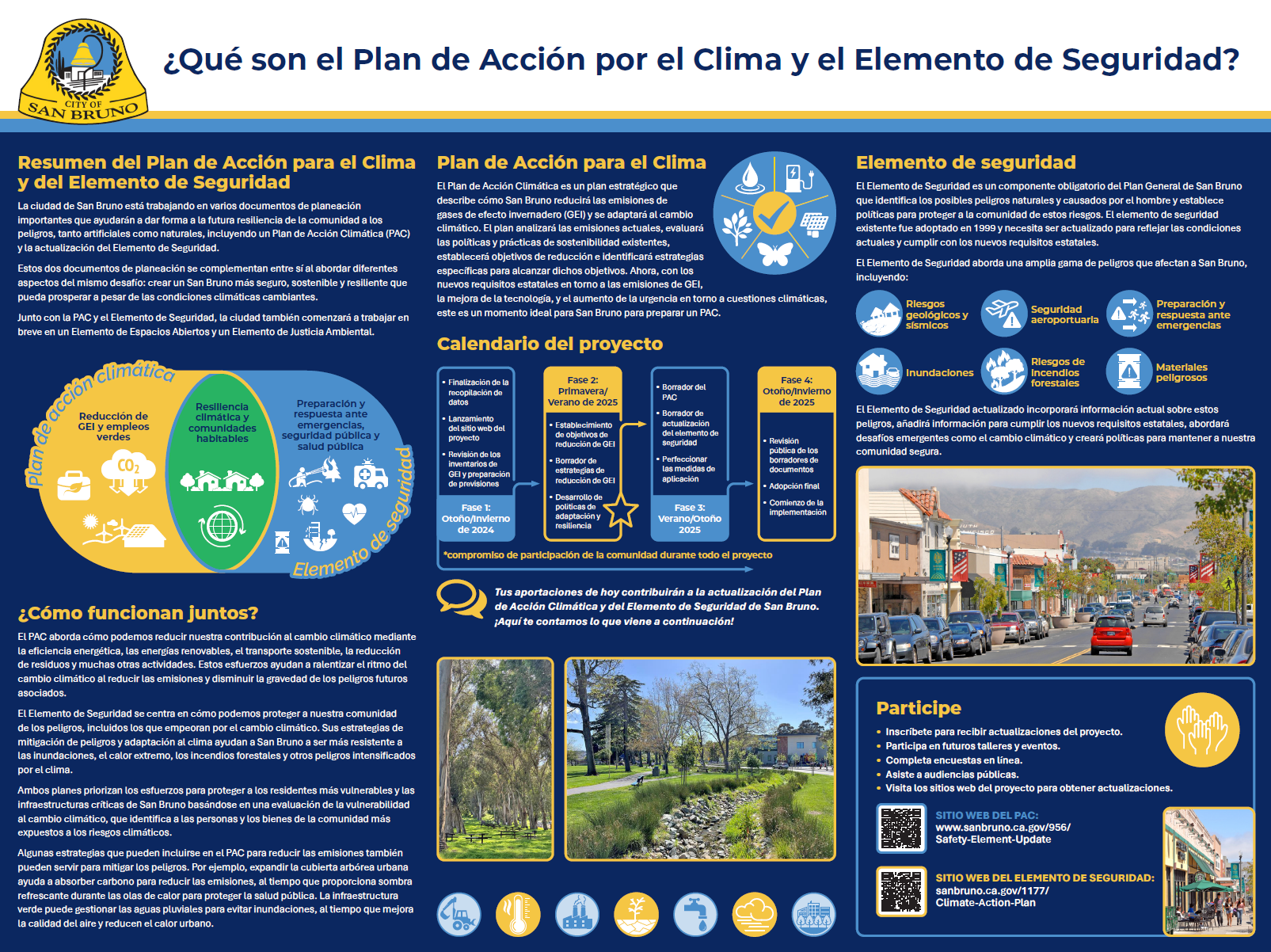
Community members joined us at the Recreation and Aquatics Center to learn about climate change issues affecting the community. Members had the opportunity to provide input on GHG reduction, policy priorities, and how climate change affects their communities.
It's not too late to provide input! Please email staff below to provide input on the PDF climate boards or priorities for your community.
Get Involved
Follow the City's social media accounts:
Visit this webpage for the latest information.
Contact:
Assistant Community Development Director: Kelly Beggs kbeggs@sanbruno.ca.gov